

Recession marketing for service businesses is what separates companies that survive downturns from those that quietly disappear. After running a business magazine for 10 years, helping hundreds of companies navigate economic crashes, and rebuilding twice myself, here is what actually keeps the phone ringing when marketing budgets get cut to zero.
Look, I’m not going to sugarcoat this.
The economy feels shaky right now. If you’ve been in business long enough, you know the pattern.
When oil hits $100 a barrel, everyone’s a genius. Contractors turn down work. Truck dealerships can’t keep inventory. “Marketing” just means answering your phone.
But when the boom goes bust, and it always does, the silence is brutal.
I’ve seen this cycle three times now. 1990s in the UK. 2008 in Spain. 2014-2016 here in Alberta. The businesses that survive aren’t the ones with the biggest marketing budgets during the good times. They’re the ones who know how to pivot fast when things go sideways.
Here’s the thing nobody tells you: economic downturns are when you can really steal market share from your competitors.
But you can’t do it using the same strategies that worked during the boom.
This isn’t theory. This is recession marketing for service businesses in practice, what I used to help companies survive when I ran my magazine in Spain through the 2008 crash. And what works right now for service companies generating consistent leads in an unpredictable economy?
Recession Marketing for Service Businesses: The “Order Taker” Delusion
During boom years, most small business owners aren’t honestly marketing.
They’re order-taking.
Boom Marketing: “We’re the best roofers in [your city]. Call us for a quote!”
Result: Phone rings because people have money and no time.
When the economy tightens, money becomes expensive and time becomes cheap. Customers stop impulse-buying. They stop renovating for fun. They stop replacing perfectly good equipment just because something newer exists.
If your website and Google Ads are still set up for “Boom Mode,” selling high-ticket luxury upgrades and “nice-to-haves,” you’re going to starve.
The businesses I helped through my magazine that survived? They weren’t the flashiest. They were the ones who understood this shift before their bank account forced them to.
1. The Pivot: Repairs Beat Replacements
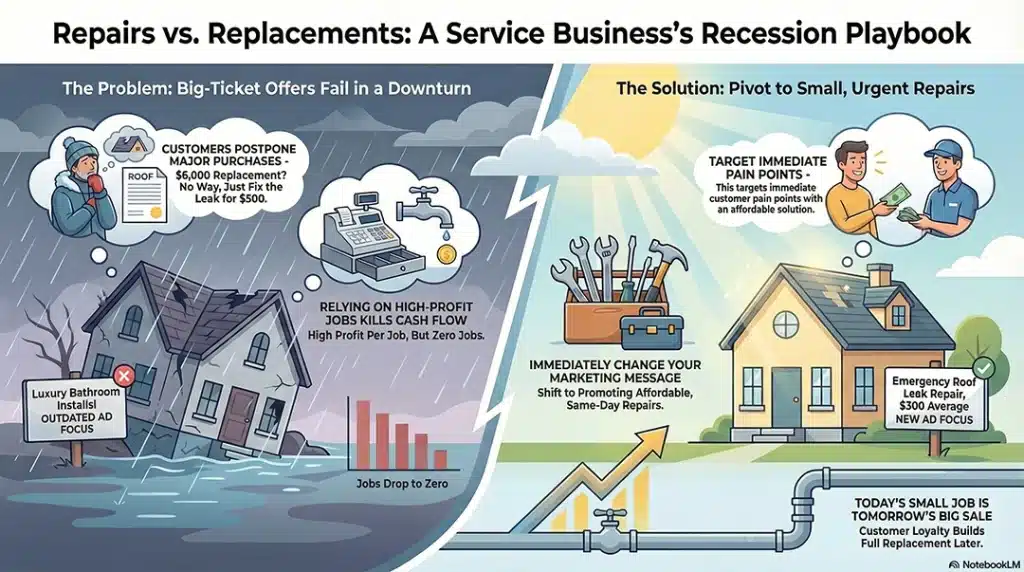
Why small, urgent repairs outperform big replacements during a recession
In a recession, nobody buys a new roof if they can patch the old one.
Nobody replaces a $6,000 furnace if a $300 repair buys them one more winter.
The biggest mistake I see? Businesses are clinging to their “Big Ticket” offers because that’s what they’re used to selling.
What’s killing you:
- “We install luxury bathrooms!” (Nobody’s buying these right now)
- “Full flat roof replacements starting at $28,000!” (Too expensive)
- “Complete HVAC system upgrades!” (Not when rent’s due Friday)
The fix:
Change your Google Ads headlines today.
Stop shouting about installations. Start promoting:
- “Emergency roof leak repair, $300 average”
- “Furnace tune-up keeps you warm all winter, $150”
- “Fix your leaking tap before it costs you $1,000, same day service”
Real example: Change your primary Google Ads campaign from “Commercial flat roof installation [your city]” to “Emergency flat roof leak repair [your city], same day service.”
You’ll make less profit per job. True.
But you’ll keep cash flowing. Keep your crew busy. And most importantly, you’ll get into the customer’s house.
When the market turns back up, and it will, guess who they call for the full replacement?
The guy who kept their roof from leaking when they were broke.
2. Your “Recession Insurance” Sits in Your Filing Cabinet
When the economy crashes, the cost to acquire a new customer often triples. Fewer people are actively looking. Fighting for new leads on Google becomes a bloodbath of rising ad costs and shrinking margins.
This is where most businesses fail.
They keep throwing money at Google, hoping for strangers to call.
The smart move?
Ignore the strangers for now. Look at your past clients.
If you’ve been in business for five years, you’ve got a goldmine sitting there. These are people who already trust you. Already know your work. Already have your phone number somewhere.
Here’s the math:
You’ve completed 400 jobs. Just 10% book a $300 maintenance check. That’s $12,000 in work without buying a single new lead.
The strategy:
Pick up the phone.
Not email. Not a newsletter. Call them.
The script: “Hi [Name], it’s Peter from [Your Company]. Look, money’s tight for everyone right now, so we’re focusing on helping our past clients avoid big repair bills. We’re doing discounted pre-season checks to make sure your [roof/HVAC/plumbing] doesn’t fail on you this winter. Can I book you in for next Tuesday?”
This isn’t salesy. It’s genuinely helpful.
You’re preventing a $5,000 emergency by catching a $200 problem early.
While your competitors go bankrupt chasing new customers, you’re surviving on the relationships you already built.
**PRO TIP:** Need help getting found by Alberta customers searching for emergency services? Our complete guide walks you through optimising your Google Business Profile, setting up location-specific pages, and ranking for “near me” searches in Edmonton, Calgary, and surrounding areas. Read: Alberta Small Business Local SEO Guide
3. Kill the “Brand Awareness” Fluff Right Now
In 2008, I watched companies go under because they were spending thousands on “getting their name out there.”
Bus benches. Radio jingles. Sponsorship deals that “raised visibility.”
When the economy’s good, you can afford to pay for “exposure.” When the economy’s bad, if it doesn’t make the phone ring in 24 hours, cut it.
You need Direct Response marketing only.
Not branding. Not “thought leadership.” Not “building your presence.”
Brand Marketing: “[your city] premier choice for quality roofing since 1995.” (Vague, useless, expensive)
Direct Response: “Roof leaking? We can fix it today for $300. Click to book.” (Specific, solves pain, asks for sale)
Every single dollar you spend must have a direct line to a sale.
If an agency tells you they’re “building your brand equity” during a recession, fire them. You can’t pay your mortgage with brand equity.
**PRO TIP:** Want to see exactly how direct response marketing works for service businesses? This case study shows the complete SEO and local marketing strategy that generates consistent leads for plumbers in Sherwood Park, including the specific keywords, content types, and conversion tactics that actually bring calls. Read: SEO for Plumbers Sherwood Park
4. The “Lipstick Effect” in Home Services
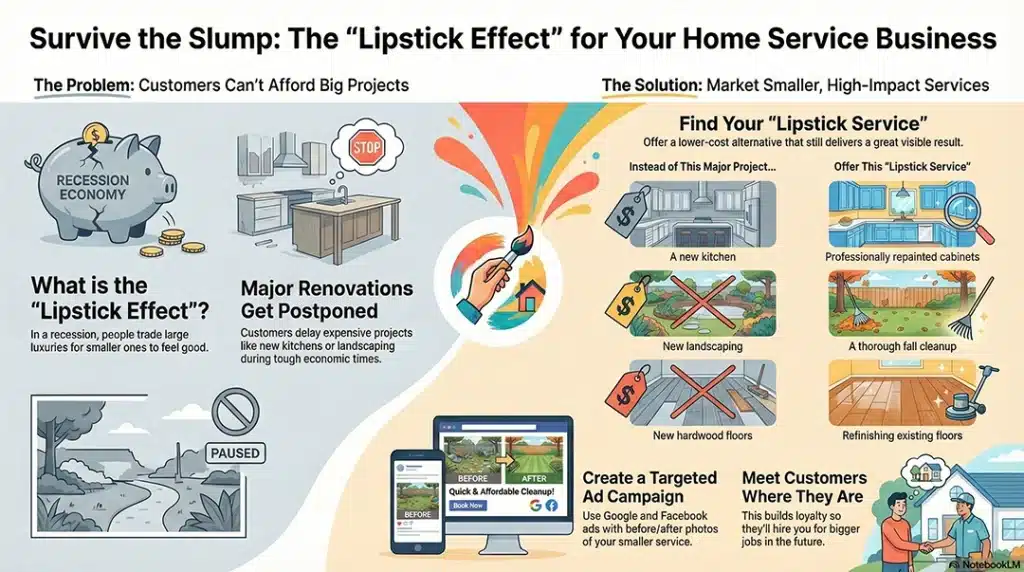
How smaller, high-impact services keep customers spending during a recession
Economists talk about the “Lipstick Effect.” During recessions, consumers stop buying fur coats, but they still buy lipstick. They trade down to smaller luxuries that make them feel good without breaking the bank.
In home services, this happens too.
People stop building extensions. But they still want their home to feel decent.
Examples of “lipstick services” you should promote:
- Can’t afford new landscaping → Will pay for really good fall cleanup
- Can’t afford new kitchen → Will pay to have cabinets professionally repainted
- Can’t afford new flooring → Will pay to have hardwood refinished
- Can’t afford bathroom reno → Will pay for new fixtures and a deep clean
Find the “lipstick service” in your industry. The lower-cost option that still gives the customer a visible result. And market it hard.
How to do this:
- Look at your most expensive service
- Find the smaller version that costs 60-80% less
- Create a Google Ads campaign specifically for that service
- Run Facebook ads showing before/after photos of the smaller service
- Track which one brings more calls right now
This isn’t about abandoning your premium services. It’s about meeting customers where they are today, so you’re still around when they’re ready to spend more tomorrow.
What’s Actually Happening in Alberta (2025-2026 Reality Check)
Here’s what makes Alberta different from other markets.
Our economy doesn’t just slow down. It swings wildly based on global oil prices we can’t control.
Since 2014, Alberta’s oil industry has gone through structural changes that mean the boom-bust cycle hits harder. Automation and consolidation mean when drilling picks up again, it doesn’t always bring back the same number of jobs.
That hits contractors and service businesses hard. Your customers’ income becomes unpredictable.
What this means for you:
You can’t just “wait for the next boom” anymore.
You need to build a business that works in both economic conditions.
The businesses that survive in Alberta 2025-2026 are the ones diversifying their customer base beyond just oil patch workers. That means targeting:
- Government employees (stable income)
- Healthcare workers (recession-resistant)
- Retirees (fixed income but consistent)
- Property management companies (always need maintenance)
Economic downturn patterns and consumer spending cycles during recessions are tracked extensively by national economic institutions.
**PRO TIP:** Rebuilding after losing everything taught me lessons you can’t learn from courses or conferences. This article covers the exact marketing strategies I used to start over multiple times, including what worked in different economic conditions and what was a complete waste of money. Read: Starting Over: Marketing Lessons
Summary: Don’t Be a Victim of the Cycle
I’m not trying to scare you.
Maybe the market won’t crash hard this time. But living in Alberta for over 13 years has taught me one thing: trees don’t grow to the sky.
If you’re worried about surviving the next downturn, recession marketing for service businesses starts with one thing: working your existing customer list instead of watching the news.
Your action plan for this week:
- Shift your message from luxury/replacement to repair/maintenance
- Call 10 past clients and offer them a discounted check-up
- Cut one “brand awareness” expense and put that money into Google Ads for emergency services
- Create one “lipstick service” offer that costs 60-80% less than your premium service
The businesses that survive recessions aren’t the ones with the best logos; they are the ones applying recession marketing for service businesses when others freeze.
They’re the ones who are the most useful when money’s tight.
Get the Complete System
I’m Peter Coscolin.
After running a business magazine for 10 years in Spain, helping hundreds of companies navigate the 2008 crash, then rebuilding in Alberta through the 2014-2016 downturn, I know what really brings in customers when you can’t afford expensive marketing.
The complete system for recession marketing for service businesses is available in my 3-book bundle for $47, built specifically for service businesses navigating downturns. Not $47/month. Just $47 total with lifetime updates.
What you get:
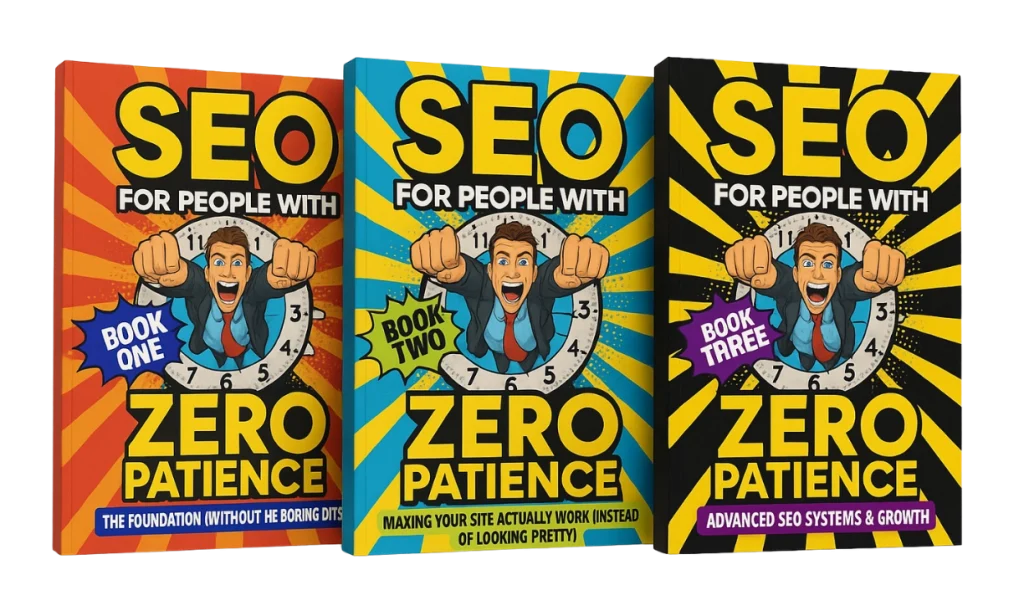
Book 1: The 81-Point SEO Foundation
Google Business Profile optimisation. Website basics. Content strategy. Review systems. Local SEO. Schema markup. The foundation every service business needs to get found online.
Book 2: Industry-Specific Playbooks
Dedicated chapters for contractors, trades, and service businesses. Specific keywords for your markets. Content ideas that bring in leads during good times and bad times. Seasonal strategies that work in your cities and beyond.
Book 3: The Technical Implementation Workbook
Step-by-step walkthroughs. What to do when Google Ads aren’t working. How to fix your website when it’s not bringing calls. This is for when you’re ready to execute, or when you hand it to someone who’ll do it for you.
Plus: Lifetime Updates
Google changes constantly. When they do, you get updated books automatically. No expiration. No monthly fees. Buy once, stay current forever.
Or if you’d rather just talk this through, email me: peter@marketinggrowthhub.com
Your Next Steps
This Week:
- Audit your Google Ads and website. Are you still selling “boom time” services?
- Pull your customer list from the past 3 years
- Call 10 past clients with a genuine maintenance offer
- Calculate your “lipstick service” pricing (60-80% less than premium)
This Month:
- Shift 50% of your ad budget to direct response offers (repairs, maintenance, emergency services)
- Set up a simple spreadsheet to track which past clients book work
- Create one piece of content targeting “recession-resistant” customer segments
- Test one new marketing channel that costs less than $200
This Quarter:
- Build a systematic past-client contact schedule (quarterly check-ins minimum)
- Diversify beyond oil patch workers as primary customer base
- Cut at least one “brand awareness” expense that doesn’t generate trackable leads
- Measure which marketing channels bring calls vs which just “feel good”
Remember:
You don’t need to do everything at once. You need to do the right things consistently. Start with past clients. Shift your message to repairs and maintenance. Cut anything that doesn’t make the phone ring.
The businesses that thrive through your city’s boom-bust cycles aren’t the lucky ones. They’re the prepared ones.
Frequently Asked Questions About Recession Marketing for Alberta Service Businesses
How long does a typical Alberta economic downturn last for service businesses?
Based on the last three cycles, expect 18-36 months of tighter conditions once a downturn starts.
The 2014-2016 oil crash? Took about 24 months before service businesses saw consistent recovery in Alberta. However, you can stay profitable throughout if you pivot your marketing strategy early. Ideally, before you see a drop in calls.
Should I cut my marketing budget during a recession?
No.
Cut the wrong marketing, not all marketing. Kill brand awareness spending (bus benches, radio ads, sponsorships) and shift that money into direct response channels. Google Ads for emergency services. Past client outreach. Maintenance offers.
Businesses that go silent during downturns lose market share they never get back.
How much should I discount services during economic uncertainty?
Don’t discount your core services.
Instead, create lower-cost alternatives. Maintenance packages. Tune-ups. Inspections. Priced at 60-80% less than your premium service.
For example, if your average roof replacement is $15,000, offer a “roof health inspection and minor repairs” package for $300-500. This keeps cash flowing without training customers to expect discounts on big jobs.
What’s the best way to contact past clients without seeming desperate?
Call them directly. Not email.
Use a genuine maintenance offer positioned as helping them avoid expensive emergencies.
Script: “Hi [Name], money’s tight for everyone, so we’re helping past clients avoid big repair bills with discounted pre-season checks.”
This is useful, not salesy. Offer specific value and a limited number of spots.
How do I compete when customers are choosing the cheapest option?
Stop competing on price.
During downturns, position yourself as the company that prevents expensive problems. This justifies slightly higher prices because you’re saving them money long-term.
Use your past client relationships. Your reviews. Your proven track record. Cheap competitors can’t match your existing trust and reliability.
Should I expand my service area during a recession to find more customers?
Usually no.
Expanding your service area increases costs (travel time, fuel, logistics) right when margins are tight. Instead, deepen your penetration in your existing area. Mine your past client list. Target recession-resistant customer segments (government employees, healthcare workers, property managers) within your current geography.
How quickly should I pivot my marketing message when I see economic warning signs for my service business?
Immediately.
Recession marketing for service businesses works best when you pivot before the phone stops ringing. The moment you see economic indicators shifting (oil prices dropping, construction permits declining, competitors advertising “big sales”), start testing repair/maintenance messaging alongside your premium services.
This gives you data before you’re desperate.
What marketing channels work best during Alberta recessions?
Google Ads for emergency and repair services (high intent, fast results). Direct outreach to past clients (lowest cost per sale). Local SEO (free ongoing traffic).
Cut: broad social media campaigns, brand awareness advertising, and anything you can’t directly track to phone calls or bookings.
How do I know if my “lipstool service” pricing is right?
Test it.
Offer your lower-cost service to 20 past clients at your proposed price. If 15% or more book it, your pricing is right. If fewer than 10% book, it’s probably too expensive or not valuable enough.
Aim for 15-25% conversion on past client offers, 5-10% on cold traffic.
Should I keep my premium services available during downturns?
Yes, absolutely.
Some customers always have money. They’ll pay for premium work even during recessions (insurance jobs, commercial property owners, wealthy homeowners). Just don’t make premium services your only offer.
Run premium and budget-friendly options simultaneously. Track which generates more revenue month-by-month.


