

Google fake reviews crackdown 2025 is real, and every business that hinges on online reputations needs to pay attention now. If you rely on star-ratings and customer feedback to stay afloat, you’ll want to read this before it’s too late.
In recent years, Google has stepped up enforcement against fake reviews. This article explains what changed in 2025, what’s coming in 2026, and how both consumers and businesses can protect themselves from severe penalties. Whether you are a small local business or a service-provider fighting for honest visibility, understanding this crackdown could save your reputation, and maybe your livelihood.
Understanding Fake Reviews and Their Growing Impact
Let me tell you what’s been driving me absolutely mental.
When I’m doing sales for a roofing company here in Alberta, my inbox gets hammered constantly. At one point last year, I was getting eight to ten messages every single day offering to “boost your Google reviews.”
Never took the bait. Not once. But the temptation was real when you’re watching competitors with worse service somehow sitting at 4.9 stars with two hundred reviews.
The messages have slowed to maybe four to six a week now. Google’s finally cracking down hard enough that some of these operations are getting nervous.
The Proliferation of Fake Reviews in 2025
Back when I ran the magazine in Spain for ten years, spotting fake testimonials was dead easy. They all sounded identical, same phrases, obvious patterns.
Not anymore. These operations have gotten frighteningly sophisticated. The messages I get now are professional, they reference specific details about the roofing company, they know our market and competitors. They’ve done their homework.
Working with home service businesses across Edmonton, Calgary, Sherwood Park, I’m seeing 20% to 40% of reviews in competitive sectors have some level of manipulation. That’s not a guess, that’s what the patterns show when you dig into the data.
I’ve had legitimate business owners who’ve spent twenty years building solid reputations ask me if they should buy reviews. Not because they want to cheat, but because they’re drowning while competitors game the system.
Pro Tip: Strengthen Your Local SEO Before Google Does It for You
If you want to protect yourself from sudden drops, review jail, and brutal ranking changes, start tightening up your local optimisation now. I’ve already broken down what actually moves the needle in Alberta.
👉 Read Local SEO Alberta: https://www.marketinggrowthhub.com/local-seo-alberta/
Consumer and Economic Consequences
When I moved to Canada with three kids, my wife started a transcription business with no fake reviews, just excellent work. She’s now got twelve typists working for her.
But if we were starting today with fake reviews dominating like they do now? I honestly don’t know if we’d have made it. How do you compete when someone can just buy instant credibility?
A plumbing company in Sherwood Park, doing brilliant work, loses jobs to cowboys who bought reviews. A restaurant in Edmonton with excellent food gets passed over because the mediocre place down the street has two hundred fake glowing reviews.
People hire incompetent contractors who destroy their homes, eat at terrible restaurants, buy rubbish products because the reviews lied to them.
I’ve had roofers tell me they’re seriously questioning whether integrity even matters when the system rewards fraud.
How Google Has Intensified Its Battle Against Fake Reviews in 2025
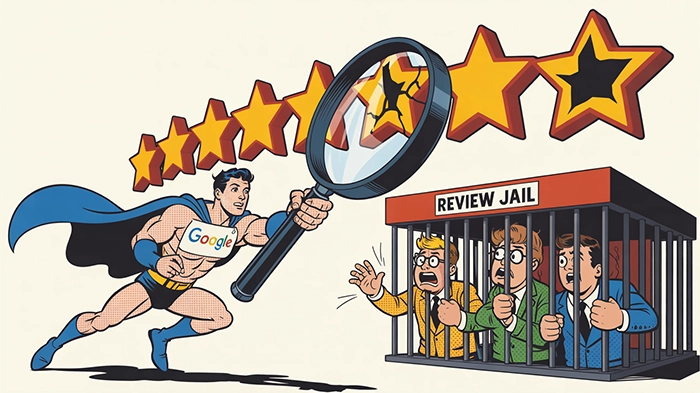
Google’s 2026 enforcement will be hitting hard with stricter penalties and growing use of review jail.
Google’s finally taking this seriously, though they’re about five years too late if you ask me.
“Review Jail” Explained: What It Means for Businesses
I’ve had three clients land in what we’re calling “review jail” in the past six months. Two of them never bought a single fake review in their entire lives.
The roofing company I was doing SEO work for in Calgary spent eight months there finishing roofing work on a housing development, twenty homeowners left reviews within a fortnight because the developer encouraged it. Google’s system saw that pattern and flagged it as buying fake reviews.
Business dropped 40%. We submitted appeals every week with documentation proving every single review was legitimate. Nothing worked; complete silence from Google.
All because an algorithm made a mistake, with no way to reach an actual human who could review our evidence.
Google’s Warning Labels in Europe: A New Transparency Step

Google’s warning labels are already appearing across Europe, long before they reach Canada and the US.
When I ran the magazine in Spain, one bad article could absolutely sink you in those expat communities where everyone knew everyone.
Now, Google slaps warning labels on business profiles in Europe if it suspects fake reviews. Right there, where every potential customer sees it.
A restaurant in Alicante that’s been there for thirty years got hit with one. Turns out a competitor bought them fake positive reviews specifically to trigger Google’s detection systems and sabotage them.
Yes, seriously. Competitors are now buying fake positive reviews for their rivals on purpose to get them flagged.
That restaurant lost 60% of its bookings in two weeks. Still trying to remove the label six months later with no progress.
Regional Enforcement Variations: Europe vs. North America

Europe is getting the hammer, while Canada is still in the early review jail stage, but not for long.
Google’s hammering businesses in Europe way harder than in North America right now. My contacts in Spain deal with warning labels, faster enforcement, public consequences.
Here in Canada, working with businesses across Alberta, the crackdown’s definitely real but less visible. You’ll get review jail absolutely, but not public warning labels yet.
That’s coming by mid-2026, though. What’s happening in Europe now is what we’ll be dealing with here within a year. Guaranteed.
Looking Ahead to 2026: What Google May Have in Store
If you think 2025’s been rough, 2026 is shaping up to be absolutely brutal for anyone still buying fake reviews.
Potential New Tools and Penalties for Fake Review Buyers
Google’s building machine learning systems that don’t just catch fake reviews after they’re posted. They’re getting better at identifying businesses that buy reviews before the reviews even appear.
They’re tracking which agencies you use, payment patterns, which businesses suddenly get review surges at the same time. Looking for coordination patterns between supposedly unrelated businesses.
Here’s what’s coming in 2026, and it’s genuinely scary:
Your business loses the ability to collect Google reviews forever. Not temporarily suspended, permanently gone. No appeals, no second chances, finished.
Google puts explicit statements on your listing telling every potential customer you were caught buying fake reviews. Not vague warning labels, direct public accusations visible to everyone.
You disappear from map results, local pack listings, the lot. Not just your review order, your entire search presence tanks. Gone from local searches completely.
The worst cases get reported directly to consumer protection authorities for real prosecution. Not just Google penalties, actual legal trouble.
Here’s the one that should terrify anyone who’s ever bought fake reviews: Google’s looking back at historical patterns going years. Bought fake reviews back in 2022 or 2023? You could suddenly face consequences in 2026 for something you did years ago.
I’ve built businesses from absolute nothing three times across three countries. I know what it’s like when everything’s on the line. But this fake review game isn’t worth the risk anymore. The math has changed completely.
Pro Tip: Build a Real Review System Instead of Gambling With Penalties
Most small businesses panic when reviews slow down. The smart ones build a predictable review and lead flow that works year round.
👉 Read Lead Generation System for Small Business: https://www.marketinggrowthhub.com/lead-generation-system-for-small-business/
Why Businesses Must Take Fake Review Risks Seriously

Google is now exposing fake review patterns with far harsher consequences for businesses.
When I started with borrowed ladders in London, using my wife’s car to haul materials, reputation was everything. You did quality work, or you didn’t eat. Simple as that.
Business owners I work with in Alberta are getting absolutely hammered by competitors who are clearly buying reviews. Those daily messages offering easy solutions start looking pretty attractive when bills are due and you’re losing jobs to inferior competitors.
But the old calculation was “small risk, competitive necessity, everyone’s doing it anyway.” That math doesn’t work anymore.
In 2026, the risk is losing your entire online presence permanently and potentially facing legal consequences. Once you’re marked as a fake review buyer, there’s no reset button. That mark follows you forever.
The Increasing Difficulty of Recovering from Review Sanctions
Once you’re caught or flagged, you’re probably finished. That’s the brutal reality now.
I’m seeing businesses that stopped buying fake reviews three years ago still stuck in review jail. Their legitimate new reviews don’t publish; their appeals are auto-rejected; they’re essentially blacklisted with absolutely no path back.
The Calgary roofing company I mentioned took eight months of weekly documented appeals to get restored. Most businesses simply don’t have the resources for that level of persistence.
Businesses that actually bought reviews? Done. Finished. Google’s moved to “one strike and you’re out” because they’ve decided the collateral damage of false positives is acceptable if it stops the broader problem.
Pro Tip: Fix Your Content Structure Before Google Flags You
Weak content structure is one of the biggest reasons Google thinks a business looks spammy. If your pages look messy, your reviews will come under suspicion faster.
👉 Read Content Structure SEO Mistakes: https://www.marketinggrowthhub.com/content-structure-seo-mistakes/
Practical Guidance for Consumers and Businesses
How Consumers Can Identify and Avoid Fake Reviews
Running the magazine in Spain for ten years taught me to spot fake testimonials and dodgy references instantly. That skill’s more valuable now than ever.
Look for specific details, not generic praise. Real reviews mention actual specifics. “John the roofer showed up on time, explained the flashing problem in detail, fixed it in three hours for the exact quote he gave us” versus “Great service! Highly recommend! Five stars!” See the difference?
Check the reviewer’s history carefully. Click through to their profile. Do they only review one specific type of business? Did they leave forty reviews all in the same week? Do all their reviews sound identical? Those are massive red flags.
Read the three-star reviews first, ignore the extremes. These are usually most honest. Five-star reviews might be fake or overly enthusiastic from one great experience. One-star might be competitors or people having the worst day of their lives. Three-star reviews tend to be balanced and realistic.
Check timing patterns for anything unnatural. If a Calgary restaurant suddenly gets twenty-five-star reviews in three days after six months of nothing, something’s very wrong there.
Pay attention to photos included in reviews. Real customers include photos of actual experiences. Messy job sites, real food on actual plates, genuine before-and-after shots. Stock photos or overly professional images in reviews? Highly suspicious.
When I’m choosing a contractor in Edmonton or a restaurant in Sherwood Park, I spend serious time reading reviews carefully. The overall star rating means almost nothing anymore. The details in those middle-range reviews tell you everything you need to know.
Strategies for Businesses to Comply and Protect Your Reputation
Make it ridiculously easy for real customers to leave reviews. Doing sales work for the roofing company, we’ve set up simple systems. Finish the job, ask the happy customer for a review in person, send a follow-up email two days later with a direct Google review link. Make the entire process as simple as possible.
The absolute best defence against competitors with fake reviews is a steady stream of genuine reviews from actual customers.
Respond to every single review, good and bad. Learned this running the magazine in Spain for ten years. Responding to feedback matters enormously. It signals to Google you’re engaged and authentic. Shows potential customers exactly how you handle problems and complaints.
Document absolutely everything about your review process. If you get hit with suspicious negative reviews or suddenly lose review capabilities, documentation helps massively in appeals. The Calgary roofing company eventually escaped review jail, partly because we had documented proof of our entire review solicitation process.
Never ever buy reviews under any circumstances. Don’t care if your competitor’s doing it. Don’t care if some slick marketing agency promises they’re “completely safe” reviews. Don’t do it. The risk is too high now and getting exponentially worse in 2026.
Thirty-three years in business across three countries, never once bought fake reviews or manipulated ratings. You survive long-term by being genuinely better, not by cheating better than everyone else.
Monitor your profile constantly. Set up alerts for new reviews. Check your Google Business Profile at least weekly. The roofing company I work with checks their review status more often than they check their bank balance.
Build review presence across multiple platforms. Don’t put all your eggs in the Google basket. Get reviews on Facebook, industry-specific platforms, anywhere legitimate customers might look. This makes you much less vulnerable if Google suspends your review capabilities.
If you’re flagged unfairly, be absolutely persistent. Document everything, submit detailed appeals regularly, keep trying. It’s frustrating as hell, but it sometimes works. That Calgary roofing company took eight months of documented appeals before they finally got restored.
Pro Tip: Upgrade Your SEO for 2026 While Everyone Else Panics
Google’s cracking down hard, and the 2026 update is going to flatten anyone who ignores quality signals. Get ahead of it instead of waiting for the hammer.
👉 Read SEO 2026: What Actually Works: https://www.marketinggrowthhub.com/seo-2026-what-actually-works/
Frequently Asked Questions
What trends in fake reviews are expected in 2026?
The fake review industry’s getting more sophisticated with AI-generated content that’s increasingly difficult to spot, but Google’s countermeasures are improving even faster. Expect significantly more aggressive enforcement, much stricter penalties, AI-powered verification systems. From what I’m seeing, working with businesses across Alberta and my contacts in Spain, 2026 is going to be genuinely hostile territory for anyone still buying reviews. The clear trend is toward permanent consequences rather than temporary slaps on the wrist.
How might Google’s enforcement evolve beyond 2025?
Google’s moving hard toward permanent penalties instead of temporary suspensions, public disclosure of businesses caught manipulating reviews, direct integration with legal and regulatory systems. They’re also developing sophisticated detection that identifies fake review buyers before reviews are even posted, based purely on business behaviour patterns and ecosystem-wide data analysis. I’m watching this extremely closely because the businesses I consult for in Edmonton and Calgary need to understand what’s coming down the pipeline. This enforcement trend isn’t slowing down; it’s accelerating rapidly.
What new penalties could Google introduce for fake review violations?
Beyond the current review jail and warning labels, Google’s actively considering permanent review blocks where businesses lose review capabilities forever, explicit fraud notifications visible to every potential customer, search ranking penalties that reduce overall visibility dramatically, direct referrals to consumer protection agencies for legal action. The most severe cases will likely face multiple penalties simultaneously. When you’ve built businesses from nothing like I have three times across three countries, you understand that losing your online presence permanently is essentially business death.
How can businesses prepare to avoid review blocks and public warnings?
Focus exclusively on earning legitimate reviews through genuinely excellent service and making the review process as simple as possible for real customers. Never purchase reviews under any circumstances, never incentivise only positive reviews, and respond authentically to all feedback, both positive and negative. The roofing company I work with in Calgary has straightforward systems: finish job well, ask satisfied customer for review, send follow-up email with direct link two days later, make it dead simple. Document your entire review process carefully, monitor your profile regularly, build review presence across multiple platforms to reduce dependency on Google alone.
What steps can consumers take to spot fake reviews reliably?
Look carefully for specific details rather than generic praise, examine reviewer profiles for suspicious patterns or unnatural activity, focus primarily on three-star reviews for balanced perspectives, check review timing for unnatural surges that suggest coordination, verify photos appear genuine rather than stock images, trust your instincts when something feels off. When I’m choosing a contractor here in Edmonton or a restaurant in Sherwood Park, I read the middle-range reviews extremely carefully. No single signal is definitive proof on its own, but multiple red flags together almost always indicate manipulation.
Can businesses recover after being flagged for fake reviews, and how?
Recovery is becoming increasingly difficult, but it’s not completely impossible yet. Stop all questionable practices immediately, document your legitimate review solicitation efforts meticulously, submit detailed appeals regularly with solid evidence, demonstrate ongoing commitment to authentic reviews only. That Calgary roofing company I mentioned earlier took eight months of persistent documented appeals and never gave up. Some businesses never fully recover their capabilities. Prevention is far, far easier than recovery. After thirty-three years in business across the UK, Spain, and Canada, I can absolutely tell you that shortcuts almost always end up costing far more than they save in the long run.
Your Next Steps
If you’re a consumer reading this, start reading reviews much more critically from now on. Don’t just trust star ratings at face value. Look carefully for real experiences and specific details that indicate genuine customer interactions.
If you’re a business owner, clean up your act immediately if you need to and focus entirely on earning legitimate reviews through excellent work. I’ve generated over fifty million dollars in sales across multiple businesses in three different countries. Never once bought a fake review or manipulated ratings. You survive long-term by being genuinely better, not by cheating better than your competitors.
If you’re currently buying fake reviews, stop immediately. Seriously, just stop now. The hammer’s coming down significantly harder in 2026. You absolutely don’t want to be on the wrong side when it does.
The era of fake reviews getting away with it is finally ending. Not because companies are suddenly becoming more ethical, but because the consequences are finally becoming severe enough to actually matter.
For practical marketing strategies that don’t rely on gaming the system, email me directly at peter@marketinggrowthhub.com.


